Skip to content
find
Orange background with three connected white building blocks and the text “9 Industry, Innovation and Infrastructure.” Represents the development of resilient infrastructure and sustainable industrialization.
Navy background with five interlinked white circles forming a flower-like shape, and the text “17 Partnerships for the Goals.” Illustrates the goal of strengthening global partnerships to support sustainable development.

How Businesses Turn External Knowledge into Value?

OIC | 2026-09-16

Lukas Geryba, the Head of the Open Innovation Centre and a researcher at the School of Economics and Business, Kaunas University of Technology

Type “innovation” into a stock photo search and a familiar visual vocabulary appears. There are glowing blue networks, interconnected nodes, floating icons and carefully arranged groups of people pointing at sticky notes. They communicate activity, connectivity and technological possibility. They rarely communicate the difficult work through which knowledge becomes useful.

Caravaggio’s Saint Jerome offers a more convincing image. There is no ecosystem map, facilitated workshop or blue digital network. Jerome sits at a desk surrounded by books, paper, ink and a skull. He is studying and writing, absorbed in the demanding work of interpretation. Knowledge has reached him, but access is only the beginning.

The painting, held by the Galleria Borghese in Rome, Italy, depicts knowledge not as something that circulates, but as something that must be worked upon. That is an increasingly useful way to understand open innovation. Before that knowledge can travel further, someone must work on it.

For the past two decades, much of the open innovation conversation has concentrated on access. Organisations have been encouraged to search beyond their boundaries, engage startups, work with universities, involve customers, build ecosystems and use intermediaries to locate technologies and expertise. The central challenge is converting that knowledge into something the organisation can understand, own and use.

Happy man with curly light-brown hair, round glasses and a short beard, wearing a grey button-up shirt against a light studio background.
Lukas Geryba, Lukas Geryba, Head of the Open Innovation Centre

Access still matters. But it is becoming less scarce. The harder problem is what happens after knowledge has been found.

The Rembrandts already in the building

In 2000, Kevin Rivette and David Kline published a strategic guidebook for CEOs titled Rembrandts in the Attic: Unlocking the Hidden Value of Patents. They argued that many organisations possessed patents with considerable strategic and financial value but failed to use them effectively. In other words, the masterpieces were already inside the building. They were simply stored away, disconnected from the organisation’s active strategy. More than two decades later, the attic has become considerably larger.

It now contains patents and technologies, but also research results, customer insights, abandoned prototypes, unsuccessful pilots, unused datasets, relationships, technical expertise and ideas that failed to survive a previous budgeting cycle. Most organisations have accumulated more knowledge than they can recognise, combine or deploy. The problem is that this knowledge remains local.

If organisations struggle to mobilise knowledge they already possess, giving them access to vastly more external knowledge does not remove the problem. It can magnify it.

Open innovation can fill the attic as easily as empty it.

Open innovation is not limited to external search

Open innovation is commonly presented as a search problem. The underlying assumption that a wider search will produce better opportunities is only partly correct. Searching more widely can increase the quality and diversity of available knowledge, but it does not guarantee that the organisation will understand what it finds.

Professor Henry Chesbrough, innovation thought leader at Berkeley Haas, says that “Searching for useful external knowledge is becoming much easier for organisations. Yet understanding this knowledge, and integrating it with your own existing knowledge becomes harder as the amount of external knowledge increases.”

This is the central contradiction facing open innovation. Organisations can discover more ideas, technologies and potential partners than they have the capacity to evaluate and absorb. The search function improves, while the conversion function remains underdeveloped.

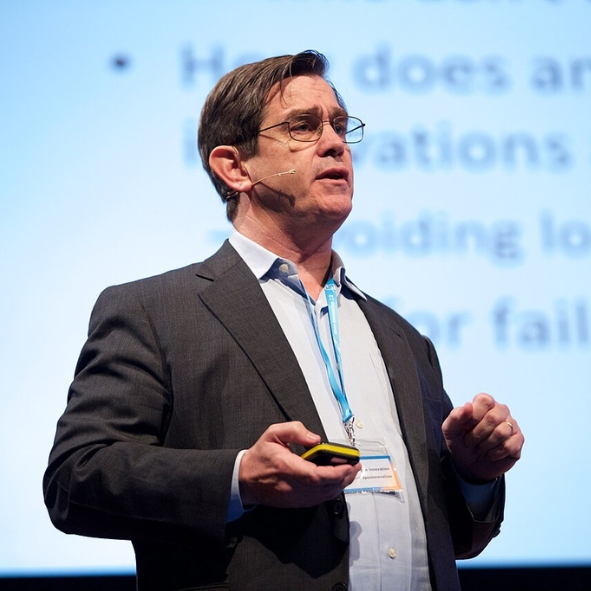
A man wearing glasses, a suit jacket, and a light-colored shirt while speaking at an event. He is shown in profile against a blurred presentation background.
Prof. Henry Chesbrough, Faculty Co-director, Garwood Center for Corporate Innovation, UC Berkeley

External search is attractive partly because it is visible. It produces startup databases, delegations, ecosystem memberships, partnership announcements, proof-of-concept programmes and photographs from innovation events. These activities can be counted, communicated and presented as evidence that the organisation is becoming more open.

Internal absorption is slower and harder. It exposes gaps in expertise, crosses departmental territories and requires managers to allocate resources to ideas that originated elsewhere. It may force a business unit to reconsider its plans, alter its workflows or stop an existing activity to create capacity for a new one.

The real blockage comes after the proof of concept

Many innovation programmes are built around the assumption that a successful proof of concept creates a natural pathway towards adoption. Once technical feasibility has been demonstrated, the expectation is that the value will be obvious and the business unit will take the project forward.

Prof. Chesbrough locates the critical blockage later in the process: “The key blockage occurs not at the beginning, in the search process, nor at the Proof of Concept stage. The blockage occurs later, as existing business units struggle to change their internal processes and workflows to incorporate external knowledge. Often, the incentives for the business unit discourage them from making these changes, since they involve some degree of increased cost and increased risk.”

This explains why technically successful projects so often fail to reach operational scale. Adoption may require new infrastructure, altered procurement arrangements, access to operational data, employee training, regulatory review or changes in responsibility. Someone must fund these changes, accept the implementation risk and remain accountable if the project disrupts existing performance.

The incentives are frequently misaligned. Innovation teams may be rewarded for finding opportunities, initiating partnerships and completing pilots. Business units are usually rewarded for maintaining reliability, controlling costs and delivering against current performance targets. The innovation team can therefore declare a pilot successful while transferring the cost, complexity and uncertainty of implementation to managers who receive few benefits for accepting them.

From the perspective of the business unit, resistance may be entirely rational. Managers are being asked to absorb immediate costs and visible risks in exchange for benefits that are delayed, uncertain and often calculated by another team. Calling this a lack of innovation culture misses the structural problem.

The gap between pilot and scale is therefore not simply a financing gap or a technological problem. It is an organisational design problem involving ownership, incentives, decision rights and resource allocation.

Activity is not capability

Many organisations evaluate open innovation through activity: startups screened, challenges launched, partnerships signed and proofs of concept completed. These indicators describe the scale of engagement, but they do not show whether the organisation can repeatedly turn knowledge into value.

A man delivers a presentation to an audience, gesturing.

Prof. Chesbrough makes the distinction explicit: “The key to distinguishing genuine open innovation capability comes not from the inputs, but instead from the outputs of the innovation activities. Successful open innovators have multiple examples of new products or services, new sources of revenue, or improvements in cost, from their use of open innovation.”

This becomes increasingly important as AI accelerates the front end of innovation. Technologies can be identified globally, researchers located rapidly and patents, scientific publications and market information searched at unprecedented scale. But organisational decision systems are not accelerating at the same rate.

As Prof. Chesbrough explains: “It takes much less time to search for a technology, or to vibe code a prototype application. But it takes just as long to get management’s attention, to get the project reviewed and approved, and to obtain budget support for carrying out the project. So these steps increasingly become the bottleneck in the innovation process.”

The scarce capability is therefore not access, but absorption. Organisations need people capable of judging what is genuinely relevant, translating external knowledge into their own technical and commercial context, and determining what must change internally for it to work.

They also need ownership. An external opportunity requires someone inside the core business with the authority, resources and incentives to move it from experiment to adoption.

This changes the questions leaders should ask. What happened after the startup was scouted? Which process changed after the proof of concept? Who owned implementation? What measurable commercial or operational value resulted?

A partnership without an internal owner remains a conversation. A proof of concept without an adoption pathway remains an experiment. The stronger the external search capability becomes, the more internal judgement, ownership and absorptive capability matter.

Bring the masterpiece downstairs

Caravaggio’s scholar offers an image of the interpretation this requires. In a business, that work is shared. Researchers explain a finding, engineers adapt it to operating conditions, and managers authorise the changes needed to use it. Bringing the masterpiece downstairs means putting knowledge into a product, service or process that delivers a measurable result.

Rivette and Kline warned that valuable patents might already be gathering dust in corporate attics. The contemporary attic contains much more. It holds knowledge that never crossed a departmental boundary, technologies that never found a business owner, pilots that never reached implementation and external ideas that entered the organisation without anyone capable of absorbing them.

AI will make more knowledge available, faster and at lower cost. It will not automatically resolve unclear ownership, competing incentives, slow decision processes or organisational resistance. By accelerating search, it may expose those weaknesses more clearly.

The masterpiece may already be in the building, or it may arrive through a startup, a university, a customer or an AI-enabled search. Finding it is only the beginning. Competitive advantage and value is created when the organisation can recognise it, translate it, secure ownership for it and bring it downstairs. This is where an intermediary can help connect external expertise with the company’s internal decisions. At Kaunas University of Technology, the Open Innovation Centre, where Chesbrough acts as a strategic adviser, helps companies frame challenges, identify suitable experts and partners, and design collaboration and validation activities.

Other News