Skip to content
find
Orange background with three connected white building blocks and the text “9 Industry, Innovation and Infrastructure.” Represents the development of resilient infrastructure and sustainable industrialization.
Navy background with five interlinked white circles forming a flower-like shape, and the text “17 Partnerships for the Goals.” Illustrates the goal of strengthening global partnerships to support sustainable development.

Companies Are Adopting AI, but Are They Losing Control of Their Data?

OIC | 2026-11-20

The greatest threat to a company’s data security today may lie not in cyber attacks, but in employees’ everyday habits.

A single document, spreadsheet containing customer data, or internal correspondence uploaded to an artificial intelligence (AI) tool can trigger an information security incident. This means that even companies investing in cybersecurity cannot be certain their data is safe. A new challenge has emerged: how can businesses benefit from AI without losing control of their data?

Critical Assessment Is Essential

According to Prof. Dr. Šarūnas Grigaliūnas, Head of the Cybersecurity Competence Centre at Kaunas University of Technology (KTU), the greatest vulnerability arises when company information is transferred to an external service without the organisation even knowing about it.

“An employee may have the right to read a document, but that does not automatically give them the right to pass it on to an AI provider of their choice,” the professor says. “Imagine a procurement specialist asking AI to compare suppliers’ proposals. In the process, they upload non-public prices, negotiating positions, and contract annexes. The task seems routine, but the information has already been shared with a new recipient.”

Grigaliūnas also points out that connecting an email account or document repository to an AI system can result in far more extensive data transfers than uploading a single file deliberately. Discussing the situations in which employees most often cross the line without realising it, and the risks they overlook, the KTU professor highlights cases in which an ordinary task conceals a data transfer.

“Translating a contract, summarising a meeting recording, or explaining a system error may seem harmless. But a contract may contain trade secrets, a recording may include discussion of an employee’s health, and an error screenshot may display an access key. You need to assess both the content being shared and the recipient. Removing names does not necessarily guarantee anonymity, either. Suppose we remove a person’s name from a case file but leave their town, job title, the time of the incident, and unusual circumstances. The person may still be identifiable,” says Prof. Dr. Grigaliūnas.

Employee Monitoring Must Follow the Rules

But how much control do companies really have over the AI tools their employees use? Asked whether there are ways for a company to find out which tools employees use and what information they share with them, the KTU professor explains that the otherwise invisible path of data can be partially reconstructed if the company manages work devices, accounts, and access permissions.

“I would start by talking to employees: what tasks do they use AI for, and why did they choose those particular tools? That information should be compared with data on installed applications, browser extensions, logins, and granted access permissions,” says Grigaliūnas.

He notes that network logs may show that an AI website was used, but usually cannot reveal what was entered into the chat.

“In a managed environment, data loss prevention measures can identify some sensitive content, warn an employee, or block a transfer. Their effectiveness needs to be tested with specific applications and browsers. However, a personal phone or another unmanaged environment leaves gaps. Complete visibility cannot be promised,” the KTU professor explains.

He emphasises that any employee monitoring must have a clear purpose and legal basis, be proportionate, and be communicated to employees in advance.

A Paid Version Is Not Enough

Sigita Jurkynaitė, Chief Information Security Officer at nexos.ai, highlights another important consideration: controlling data is especially difficult when employees use free AI accounts or basic individual subscriptions.

“These plans are generally designed for convenience, and the data entered can remain in the provider’s systems indefinitely and may be used to improve the systems. But paying for a subscription is not enough. That is one of the most common myths companies fall for. It is important to distinguish a regular paid individual account from a genuine enterprise-level licence,” Jurkynaitė explains.

When a company purchases individual plans for its employees, nothing necessarily changes from a security perspective: in many cases, information submitted by employees is used by default to train AI models, while the company has no control over the accounts and cannot set security policies. Moreover, when an employee leaves the company, their entire history and uploaded files remain in their account.

“Enterprise licences, by contrast, can provide security in line with company requirements—but only if the organisation has checked the provider’s reputation, reviewed external audit findings and certifications, and assessed the contractual terms before signing. It is very important to obtain a list of subcontractors and know who else will have access to your data,” says the nexos.ai Chief Information Security Officer.

It Pays to Know Your Provider

Before choosing AI tools and allowing employees to use them, Jurkynaitė advises companies to establish why the tool is needed in the first place and whether another tool with the same functionality is already in use.

“If there is a genuine business need, the tool and its provider should undergo thorough due diligence. The aim is to answer what we will upload to the tool, who actually developed it, and how much control we will have over it. Depending on the context, a company may apply one set of requirements to tools generating text from public information and a very different set when contracts or financial reports are being uploaded,” she explains.

In any case, she says, it is essential to understand who developed the tool and where the data goes. “There are many AI startups on the market today that are really just graphical user interfaces; under the hood, they still connect to the same OpenAI, Anthropic, or Google systems. That is why it is essential to check the entire chain—who the actual technology provider is, which subcontractors will see your information, and which countries their servers are located in,” Jurkynaitė notes.

Finally, companies need to establish whether the provider is ready to work with business customers. She recommends requesting evidence of independent security audits, such as ISO 27001, SOC 2, or the newer AI standard ISO 42001.

“Instead of certificates, or even when certificates are provided, you can prepare a questionnaire that also includes AI-specific questions. Check practical issues such as access management: will your employees be able to sign in using their company account through single sign-on (SSO)? Will you be able to assign permissions yourselves and revoke an employee’s access with a single click when they leave?” advises the nexos.ai Chief Information Security Officer.

AI Can Become a Competitive Advantage

To reduce the risk of data leakage associated with AI use and ensure that employees use the technology responsibly, the Head of KTU’s Cybersecurity Competence Centre adds another important recommendation to the advice above: test the entire process in practice using fictional data.

“Does the system detect a prohibited transfer? Does the employee know whom to notify? Does the responsible person receive an alert and have the ability to revoke access? Does a significant action by an AI agent stop and wait for human approval? Training should be linked to the employee’s actual tasks. After such an exercise, a manager should be able to see which controls work, which need improvement, and who is responsible for them,” says Grigaliūnas.

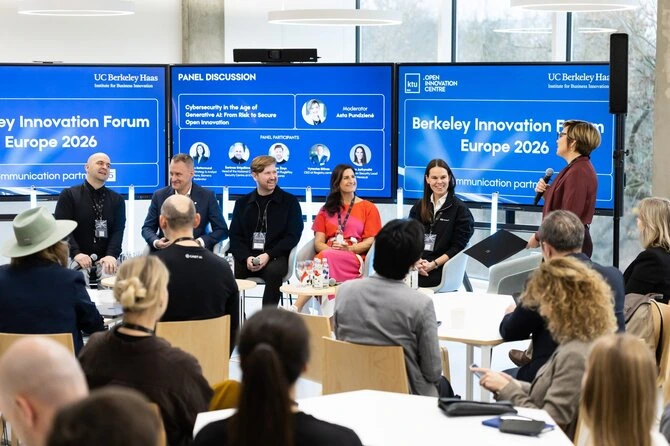
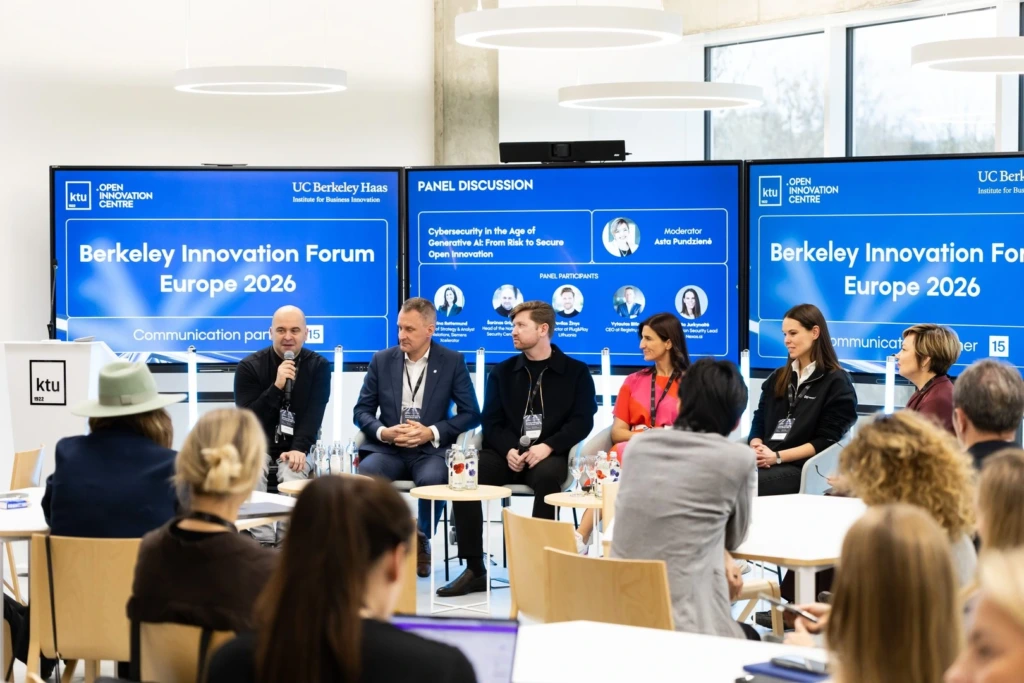
The interviewees also discussed the future of cybersecurity in the AI era at Berkeley Innovation Forum Europe 2026, held at KTU. The panel discussion “Cybersecurity Future in the Age of Generative AI: From Risk to Secure Open Innovation” examined how cybersecurity can support the secure adoption of generative AI (GenAI) and promote open innovation within industrial ecosystems.
The forum was organised by the KTU Open Innovation Centre together with the University of California, Berkeley. According to the Centre’s Head, Lukas Geryba, discussions about AI security are now inseparable from a broader question: how can organisations harness the potential of technology while retaining responsibility for their data?

“Innovation happens where organisations are not afraid to try new solutions but also understand their responsibility in using them. It is important that security requirements do not become a barrier to innovation. On the contrary, a responsibly designed environment enables companies to experiment more confidently, collaborate, and develop new solutions,” says Geryba.

The experts agree that business leaders need to understand that attempts to ban AI or specific tools do not work. If access is blocked without offering an alternative, employees will use AI discreetly through personal phones and private accounts.

“That is precisely why companies should focus on creating a safe and convenient way to use AI. It is also crucial to train the people who use these tools properly. Employees must understand what information can be entrusted to AI, how to share results safely, and why every AI-generated response needs to be critically assessed before decisions are made,” emphasises Jurkynaitė, Chief Information Security Officer at nexos.ai.

According to her, when AI is securely connected to a company’s knowledge base, with the company retaining control of its data and avoiding dependence on a single provider, AI can become not merely a fashionable novelty but a long-term competitive advantage.

Other News